Hungry for More: A Culinary Journey Through Beautiful Basque Country
Home » Blog » Spain » Basque Country » Hungry for More: A Culinary Journey Through Beautiful Basque Country
-
Written by Inbal Cabiri
- Last updated date - June 10, 2026
- No Comments
Hungry for More: A Culinary Journey Through Beautiful Basque Country
By Inbal Cabiri | Published in Atmosfera magazine, April 2025 – the in-flight magazine of El Al.
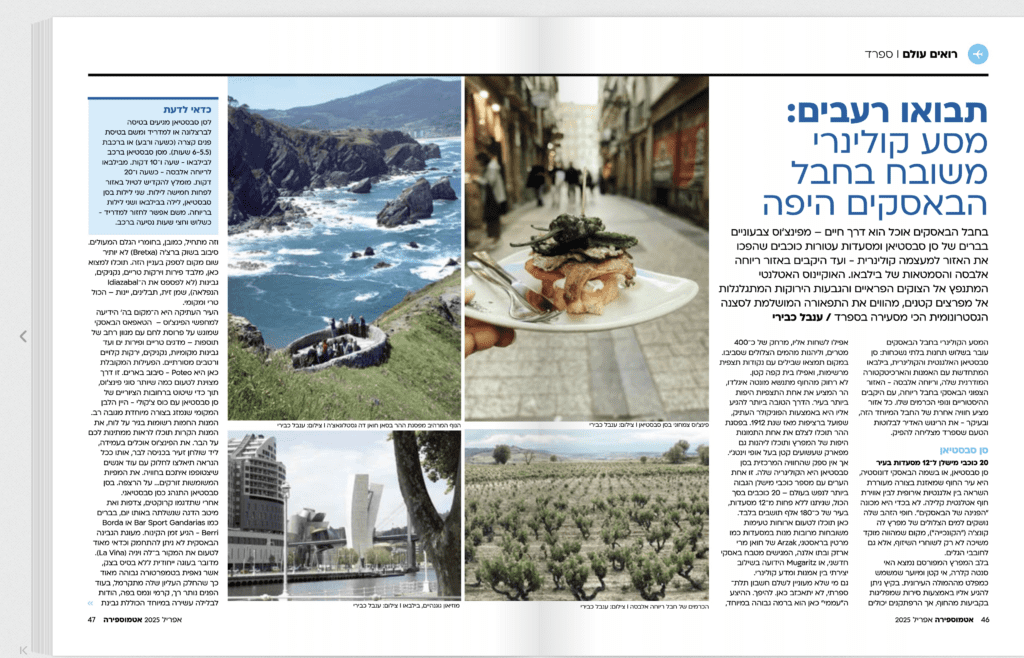
In Basque Country, food is a way of life – pintxos bars and restaurants lining the streets of San Sebastián and Bilbao have turned the region into a culinary hotspot that draws visitors from across the world. The area is also home to the Albaola shipyards in Pasaia, the iconic Guggenheim Museum and Architecture in Bilbao, the breathtaking coastal landscapes, and the ancient traditions of a people whose origins no historian has yet fully explained. All of this – from small hilltop villages to the soaring heights of the Pyrenees – adds up to one of the finest gastronomic destinations in Spain.
The culinary journey through Basque Country passes through San Sebastián, Bilbao, and the wine village of La Guardia. The region’s combination of culinary excellence, modernist architecture, the Atlantic Coast, and stunning scenery makes it one of Spain’s most remarkable travel experiences.
San Sebastián
20 Michelin Stars in a Single City
San Sebastián, or Donostia in Basque, is one of the most decorated culinary cities in the world. The city holds more Michelin stars per capita than almost anywhere on Earth. It is the epicenter of New Basque Cuisine – the movement that transformed the way Spain (and the world) thinks about food.
But San Sebastián is not only about starred restaurants. The real soul of the city lives in its pintxos bars. Here you can eat extraordinary food for less than €2 a bite – an art form that balances informality with technique. The best pintxos are not reheated finger food: they are precisely crafted small bites, served on bread or skewered, that showcase the same culinary intelligence found in the city’s fine dining rooms.
Locals don’t consider it “tapas.” The pintxo is a distinctly Basque invention – and the bars of San Sebastián take the tradition seriously.
The old town – La Parte Vieja – is the place to start. The narrow streets are lined with bars packed elbow to elbow, and the counter of each one is covered with pintxos arranged on platters. Point, eat, pay. Move to the next bar. Repeat.
Among the standout spots: Borda Berri, for slow-cooked veal cheek and risotto; and Bar Sport Gandarías, beloved for its shrimp and prawn pintxos. At night, the neighborhood transforms – the bars fill up, the streets overflow, and the food keeps coming.
Slightly away from the old town center is La Viña, a restaurant famous for its burnt Basque cheesecake – the original, the one that launched a worldwide obsession. The cheesecake is baked at high heat, deliberately charred on the outside, and gloriously creamy inside. It has nothing to do with the versions that followed it across the globe.
Bilbao
Modern Architecture in the Heart of the Basque Country
Bilbao was an industrial port city for most of its history – until a visionary urban transformation turned it into a global tourism destination. The centerpiece of that reinvention is the Guggenheim Museum Bilbao, designed by Frank Gehry and opened in 1997, which single-handedly changed the city’s identity. The so-called “Bilbao Effect” – the idea that a single iconic building can regenerate an entire city – became an urban planning concept studied worldwide.
The museum itself houses modern and contemporary art from its own permanent collection. To see the full collection and make sense of the city, the best approach is to hire a local guide – who can lead you to the river, the new buildings, the quiet corners, and the stories behind them.
Bilbao is also a city for walking. The banks of the Nervión River between the Guggenheim and the old Zubizuri footbridge – a swooping white pedestrian bridge designed by Santiago Calatrava – are among the most pleasant urban walks in Spain.
Azurmendi – A Restaurant That Grows Its Own World
Azurmendi is not just a restaurant – it is a statement about what Basque culinary tradition can become. The restaurant holds three Michelin stars and is led by chef Eneko Atxa, who has built something closer to a living ecosystem than a dining room.
The experience begins in a greenhouse, where guests walk among plants and herbs used in the kitchen. It continues in a picnic area, where the first courses are served outdoors. By the time you reach the main dining room, the meal has already told you something about the land you’re eating from.
The cooking is deeply rooted in Basque tradition – but filtered through contemporary technique and a clear environmental philosophy. Atxa is one of the most influential chefs in Europe, and Azurmendi is one of the few restaurants where the experience genuinely justifies the three stars.
Eating Well in Bilbao (Without a Reservation Six Months Out)
Not every meal in Bilbao requires a Michelin booking. The city has a thriving food scene built around accessibility.
Bassk Cheesecakers has taken the burnt Basque cheesecake – already a global phenomenon – and made it a serious seasonal craft. The menu changes with the time of year.
The covered market, Mercado de la Ribera, is one of the largest indoor food markets in Europe – built in 1929 and recently restored. It sits on the bank of the Nervión River and draws both locals shopping for produce and visitors looking for something authentic to eat. The ground floor has a bar area where the market vendors and the morning crowd mix freely.
In the heart of the old city, the Basque bar tradition continues at full volume. Arzak – the legendary four-star restaurant run by Elena Arzak and her father Juan Mari Arzak – sits just outside the center, but the family’s influence permeates the whole city. The Arzaks have been feeding Bilbao (and the world) since 1897.
La Guardia – The Beautiful Village Hidden Between Wine and History
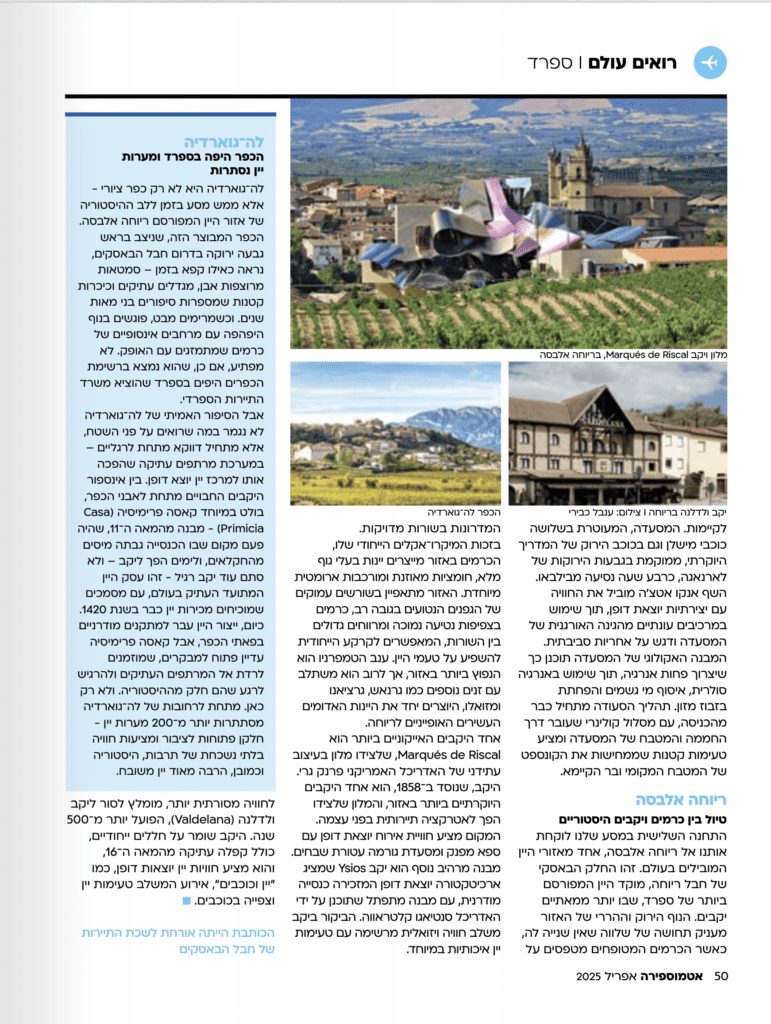
La Guardia is not just a pretty village – it is a time-travel experience through the living history of Rioja Alavesa.
The village sits on a hill in the south of the Basque Country, looking across at the green plains below. It looks, at first glance, as if time stopped here – stone facades, narrow streets, ancient fountains telling stories hundreds of years old. Conserved medieval walls open onto a stunning panorama of vineyards and countryside. Unsurprisingly, La Guardia does not appear on many tourist itineraries produced by the Spanish tourism board.
But the real story of La Guardia is not told from above. It is told underground – in an ancient winemaking system that turns beneath the village like a subterranean city. The tunnels were carved to keep wine at a constant temperature. In them, Casa Primicia – the village’s most exclusive restaurant, awarded a Michelin star, which has been the same family’s home since the 11th century – serves food in a room where nothing has changed for centuries. The cellar still holds some of the oldest wine in the world, vintages going back to the year 1420. Today the wine is made by modern methods, but Casa Primicia invites guests to come down to the historic cellar for a tasting – a rare chance to drink from a centuries-old living tradition.
For the winery’s own restaurant, Valdelana – operating for over 500 years, with a cellar dating to the 16th century – the wines come from a double-sided vineyard, producing both white and red, and the tasting menu pairs them with the landscape they came from. “Wine and stars,” as the menu puts it – everything reflected in starlight.
Rioja Alavesa – A Tour Between Historic Wineries
Our third stop on the journey takes us to the wine country of Rioja Alavesa – one of the most celebrated wine regions in the world, the Basque section of the famous Rioja appellation, where the wines are considered among the finest in Spain.
The landscape here is unique. The green hillside gives Rioja Alavesa a character unlike anything to its south – when you stand among the vineyards, you feel as if you could be somewhere in Burgundy or Tuscany.
Among the unmissable highlights of the region is Marqués de Riscal – the oldest winery in the area, founded in 1858, and the most visually extraordinary. The cellar is a heritage architecture landmark; the hotel above it was designed by Frank Gehry – the same architect who gave Bilbao the Guggenheim. The Ysios winery, designed by Santiago Calatrava (also of Zubizuri bridge fame), mirrors the Sierra de Cantabria mountains in its undulating titanium roof.
Both wineries offer tours, tastings, and meals. Booking in advance is essential.
The region also produces a unique indigenous variety – Txakoli – a sharp, slightly sparkling white wine made from local grapes, served ice-cold, poured from a height to aerate it. It pairs perfectly with pintxos. It tastes like the coast.
Getting to Bilbao
Starting point: San Juan de Gaztelugatxe
About 40 km west of San Sebastián, not far from the coast of Basque Country, lies one of the most beautiful and dramatic sites in all of Spain – San Juan de Gaztelugatxe. A small islet connected to the mainland by a stone bridge, topped with a tiny Romanesque chapel, accessible only via a staircase of 241 steps carved into the cliff.
The climb is worth every step. At the top, there is an extraordinary view over the ocean, the cliffs, and the coastline – one of the most memorable landscapes in Spain. The site inspired the creators of Game of Thrones, who used it as the fictional fortress of Dragonstone in Season 7. The show made the site even more famous, but the beauty needs no fictional backdrop.
The chapel itself is dedicated to St. John the Baptist. Legend says that ringing the bell at the top three times – and making a wish – brings good luck. The bell has been rung ten thousand times. The wishes accumulate.
The site is best visited early in the morning or late in the afternoon, when the light is low and the crowds have thinned. In summer, pre-booking a timed entry slot is mandatory.
Inbal Cabiri wrote this piece on behalf of the Basque Country Tourism Board.
Published in Atmosfera magazine, April 2025 – the in-flight magazine of El Al.
Original article

You might also be interested in -
Don't miss any new posts. Register here


Search by topic
All topics
Accommodation (7)
Architecture (1)
Beaches (3)
Beautiful sites (7)
Cafe (2)
Day trip (2)
Design (1)
Features (6)
Festivals (1)
Food (8)
Gaudi (2)
guide (1)
guided tour (2)
Hike (2)
hotels guide (5)
Kids free (0)
kids friendly (7)
Lakes (0)
map (0)
Market (1)
Michelin guide (3)
Museums (4)
observatory (3)
Outside Barcelona (1)
Recipe (0)
Restaurants recommendations (5)
Ropes Park (1)
sightseeing (2)
Slow food (0)
Slow living (2)
Spanish Food (6)
streetart (2)
Summer (1)
Sustainability (2)
Sustainable Tourism (2)
Sweets (0)
Tour (1)
Trip planning (0)
Urban travel (6)
Veggie friendly (4)
Views (3)

–
- How to Eat at Michelin Restaurants Without Breaking the Bank? October 1, 2026
- The Cheese That Tells the Story of Italy’s Aosta Valley September 14, 2026
- Everyone Loves Spain. That’s the Problem. Overtourism in Spain May 13, 2026
- Hungry for More: A Culinary Journey Through Beautiful Basque Country April 1, 2025

Looking for the most beautiful, delicious, and inspiring places?
Vicky & Cristina always know where to go.
Want to know who’s behind the scenes? Read here