Everyone Loves Spain. That’s the Problem. Overtourism in Spain

A Closer Look at Overtourism in Spain - and Why It Matters

In June 2025, people took to the streets simultaneously in Barcelona, Mallorca, Ibiza, San Sebastián, Granada, Tenerife, and Málaga. Not a WhatsApp group of activists. Real protests, with real people organizing under the banner of the Red del Sur de Europa ante la Turistificación – the Southern European Network Against Touristification – who had simply had enough. In the Canary Islands, demonstrators went on hunger strike. In Barcelona, protestors turned water guns on tourists. That image – not a sunset over the sea – became the viral photo of the summer.

Spain isn’t collapsing. But it’s changing fast, in the wrong direction, and mostly at the expense of the people who actually live there.

Spain is home to approximately 48 million residents. By 2026, projections point to 100 million tourists. Overtourism isn’t a future problem. It’s here.

When Did You Last Actually Stroll Las Ramblas?

Barcelona residents will struggle to remember. Not just because of the relentless construction. When did they last walk there unhurried, sit with a coffee, without the rumble of rolling suitcases and a cacophony of languages where Spanish and Catalan barely register? Most people I know in the city can’t say. Las Ramblas, like the Gothic Quarter, Barceloneta, and the streets around the Sagrada Família, no longer belongs to its residents. Locals pass through when they have no choice. They no longer live there – because those apartments have been converted into holiday rentals. Those who remain feel like they’re living under occupation. And they’re barely seeing a cent from it.

Where Does the Money Actually Go?

Take a hypothetical trip. A tourist flies in on American Airlines or United – neither headquartered anywhere near Madrid. She books a room at a Marriott – an American chain. She grabs lunch at Hard Rock Café – another American corporation. Orders a Starbucks. Picks up a T-shirt at Zara – yes, Spanish-founded, but publicly traded and globally operated. She does book a food tour with a local guide named Miguel, but through Viator – a TripAdvisor-owned platform that takes up to 20% cut.

Four Ways Overtourism Destroys the Places You Love

1. Eroding Quality of Life

Overtourism doesn’t just inconvenience other tourists. It primarily affects the people who have to live there – buying groceries, dropping kids at school, getting to the doctor. When city centers are effectively taken over, or when beaches become impassable in summer, these aren’t tourist problems. They’re the daily reality of residents who feel like extras in someone else’s film.

Beyond crowding, there’s noise. Destinations like Ibiza, Amsterdam, and Prague are globally recognized party tourism hubs – with consequences that ripple far beyond nighttime hours. Portugal’s national maritime authority has introduced fines of up to €36,000 for groups using loudspeakers on beaches. Not for violating quiet hours. For speakers on a beach. That’s legislation born of desperation.


2. Environmental Damage - Some of It Irreversible

Nature and infrastructure were not built to absorb millions of visitors. Tourism doesn’t just strain these systems – it leaves physical marks that take years, decades, or centuries to heal, if they heal at all.

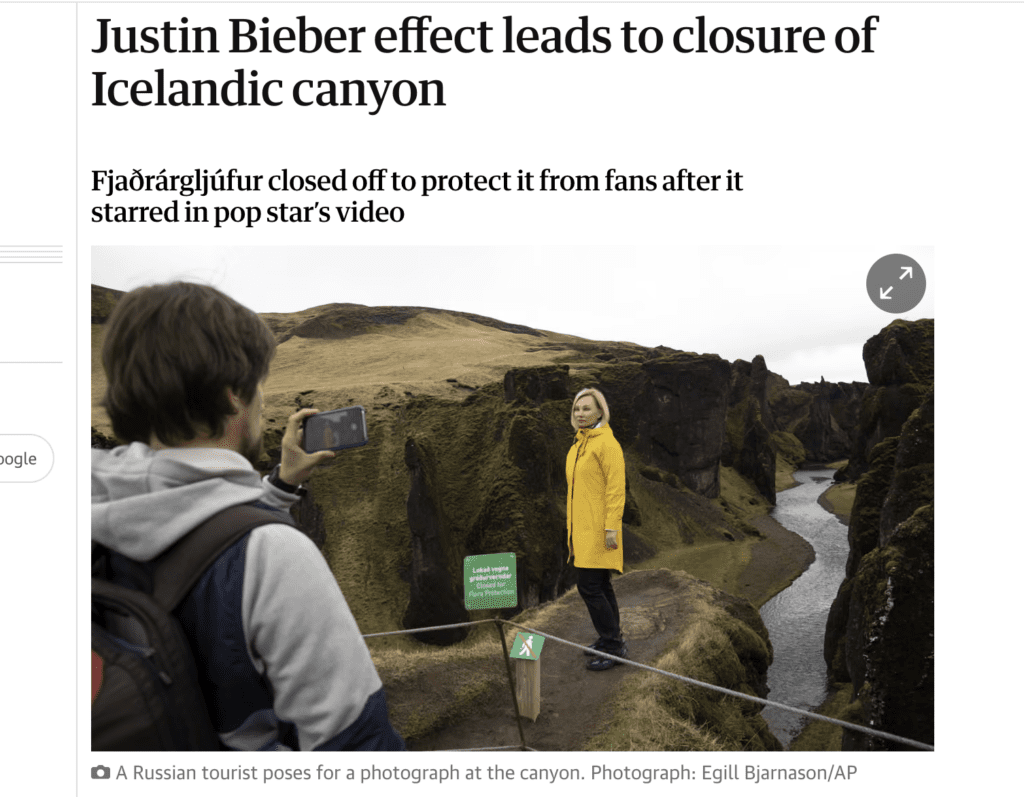
At Eldhraunin, Iceland, off-road vehicles have shattered fragile moss layers that take decades – sometimes centuries – to regenerate. Iceland has even coined an unofficial term: the Justin Bieber Effect. After the canyon Fjaðrárgljúfur appeared in one of the singer’s music videos in 2015, the site went viral. Visitors flooded in, trampled delicate vegetation, and overwhelmed an area wholly unprepared for the traffic. By 2019, Icelandic authorities closed the canyon entirely for ecological recovery. It’s become one of the world’s most cited examples of how Instagram, algorithms, and viral content can turn a fragile natural site into a casualty of its own popularity.

At Plaza de España in Seville, the famous tilework and columns have been worn and chipped under the weight of visitor footfall – forcing the city to consider entry fees simply to fund repairs. Underwater, the damage compounds: in Maya Bay, Thailand, most coral reefs have been decimated by boat traffic, pollution, and direct contact. Globally, sunscreen chemicals, fins, and physical touch are degrading reef ecosystems that have no reliable path to recovery. These aren’t isolated incidents. They’re an ongoing process of attrition.


3. The Loss of Soul

When a destination becomes over-commercialized, it loses the very qualities that attracted visitors in the first place. Independent grocers and workshops close. In their place: souvenir shops selling the same magnet, manufactured in China, now available in twenty different towns. The local barber, the corner bodega, the bar where the owner knows your name – gone. The street becomes a set. And sets can’t be anyone’s home – or anyone’s genuine travel destination.

When enough neighborhoods homogenize, and city centers across the world start to look interchangeable, enough travelers stop coming. The water guns pointed at tourists in Barcelona, the “Guiris, go home” graffiti in Seville – these are symptoms, not causes. When locals reach the point of open hostility toward visitors, it’s not just anger. It’s a sign that something deep has fractured.


4. The Economic Trap: More Tourists Doesn't Mean More for Residents

Tourism contributes to local economies – but it also creates distortions that are hard to ignore, particularly in housing. Research across Barcelona, Madrid, and Málaga links the expansion of short-term rentals to a shrinking supply of long-term housing and upward pressure on rents – alongside other factors like low interest rates and speculative investment.

In Málaga, holiday rental listings grew dramatically over the last decade, with heavy concentrations in certain central neighborhoods. In January 2025, the city froze new tourist apartment licenses in dozens of neighborhoods for three years. Meanwhile, tourism jobs are plentiful – but many are seasonal, relatively low-paid, and unstable. And cities bear rising costs for cleaning, policing, and maintaining infrastructure that degrades at accelerating speed.

The question isn’t just how much tourism brings in. It’s how much stays – and for whom.

"They Can Live Without Us. We Can't Live Without Them."

Between 2024 and 2025, mass protests swept Spain – from Madrid to the Canary Islands to Mallorca. These weren’t fringe movements or radical activists. Polling showed majority support for short-term rental restrictions across voters of every party, including the conservative PP and the far-right Vox. This wasn’t left versus market. This was a public that felt the floor disappearing beneath it – literally.

By spring 2026, preparations were already underway for a new wave of protests ahead of the tourist season. In Barcelona, Mayor Jaume Collboni announced plans to revoke all tourist apartment licenses by 2028 – a move still facing legal and political challenges, but signaling a meaningful shift in direction.

What Spain Is Actually Doing: Policy on the Ground

Barcelona has gone further than restriction – it’s moving to exit the game entirely. The city has announced it will not renew tourist apartment licenses, a move projected to remove thousands of units from the short-term market by 2028 and return them, at least in theory, to residential use. Tourist taxes have also been raised, with further increases under consideration – including a city surcharge that could push per-night costs at luxury hotels to significant levels. Part of that tax revenue is earmarked for housing initiatives. The city and port authority are also advancing a plan to reduce and regulate cruise activity, including converting and closing existing terminals.

Madrid has tightened enforcement on holiday rentals, introduced stricter licensing requirements and significant restrictions in central areas, and imposed fines on illegal operators.

Málaga froze new tourist apartment licenses in certain districts in 2025, aiming to halt sharp supply growth.

Palma de Mallorca has restricted short-term rentals and capped hotel capacity expansion in the city center, while working to manage beach use and reduce visitor pressure.

Ibiza has reinforced enforcement against illegal rentals, resulting in a measurable contraction of the unregulated accommodation supply.

The Canary Islands have introduced access restrictions at sensitive sites, including pre-booking systems in select areas to control visitor numbers.

Valencia has designated zones with differentiated short-term rental restrictions to preserve a residential-tourism balance.

The common thread: a shift from attracting more tourists to managing the load. This aligns directly with the framework of the GSTC (Global Sustainable Tourism Council) – the international body that sets the standards for sustainable tourism – which emphasizes destination management, not just destination marketing.

What We Can Do as Travelers: 5 Steps That Actually Make a Difference

1. Be intentional about where and when you go. “Not in August” is a start – but think about the time of day and the specific sites too. Distributing visitor load is one of the most effective tools available. Traveling off-season or off the beaten track is also, simply, a far more enjoyable experience.

2. Choose accommodation that puts money back into the destination. Small hotels, guesthouses, and legally registered apartments only. Every booking decision directly affects the local housing market.

3. Spend local, not generic. Family-run restaurants, independent shops, local guides. The money stays in the community rather than flowing out to international chains.

4. Respect physical and environmental limits. Stay on marked trails. Don’t touch coral. Don’t enter closed areas. Don’t fly drones where they’re prohibited – it genuinely disturbs wildlife. Most infrastructure and ecological damage is caused by “small” acts repeated thousands of times.

5. Ask yourself: what are we leaving behind? Not just in terms of waste – but for the community. The apartment a local can no longer afford. The family restaurant that closed because the landlord got a better offer from a souvenir chain. The numbers will keep climbing. Housing won’t expand to match. The pressure won’t ease on its own.

But how we travel can make a difference.


Have you encountered overtourism somewhere in the world? Share your experience in the comments – I’d love to hear it.

Leave a Reply

You might also be interested in -

כתבה איי סיאס גלובס ענבל כבירי

Cíes Islands: Spain’s Best-Kept Secret

Cíes Islands Just a short ferry ride from the city of Vigo, the Cíes Islands (Islas Cíes) feel like another world entirely. This archipelago off

Don't miss any new posts. Register here

Search by topic
about me

Looking for the most beautiful, delicious, and inspiring places?
Vicky & Cristina always know where to go.
Want to know who’s behind the scenes? Read here

Inbal Cabiri portrait

To the main blog page